
Every year around this time, the same pattern shows up in our clinic. Patients who felt fine in the dry summer months suddenly start describing stiffer knees, achier backs, and joints that feel worse the moment the first rains hit Ahmedabad. If that sounds familiar, you’re dealing with joint pain in monsoon Ahmedabad, and you’re far from alone in it.
As a pain management clinic in Ahmedabad, we hear the same question every July and August is this really connected to the weather or is something else going on. The honest answer is both can be true, and knowing which one applies to you changes what you should do about it.
Why Does Joint Pain in Monsoon Get Worse?
The link between weather and joint pain has been studied for decades, and while researchers don’t agree on every detail, the pattern itself is well documented. Harvard Medical School has reported that patients with osteoarthritis consistently show a modest but real connection between rising humidity, falling air pressure, and increased pain and stiffness.
Here’s the working theory. Your joints contain fluid and soft tissue that respond to changes in barometric pressure, the same way your ears might feel different on a flight. When pressure drops before and during rain, tissues around the joint can expand slightly. If you already have inflammation or reduced joint space from arthritis or an old injury, that small expansion is enough to press against nerve endings and trigger pain.
Humidity adds a second layer. Damp, heavy air is linked to increased stiffness, particularly in the morning, and many patients report that their joints simply feel “thicker” during the monsoon months compared to the dry season.
Who Notices Monsoon Joint Pain the Most in Ahmedabad
Not everyone feels a difference when the rains arrive. In our experience, monsoon flare ups tend to concentrate in a few groups:
- Patients with existing osteoarthritis, particularly in the knees and lower back
- Older adults, where joint cartilage has already thinned with age
- People recovering from a previous fracture or joint injury
- Patients with rheumatoid arthritis or other inflammatory joint conditions
- Anyone who becomes less physically active once the rain keeps them indoors
That last point matters more than people expect. Reduced movement during the monsoon, simply because stepping out is harder, often worsens stiffness on its own, separate from any weather-related mechanism.
In a city like Ahmedabad, this pattern has a local flavor. Naranpura and much of the western city see heavy, sustained rainfall through July and August, followed by long stretches of high humidity even without active rain. That combination of wet roads, waterlogged commutes, and sticky air keeps people indoors and sedentary longer than a single rainy day would explain, compounding the stiffness beyond the weather effect alone.
We see a similar seasonal pattern play out in winter, which we’ve written about separately in our guide on winter joint pain relief. The seasons are different, but the underlying lesson is the same: predictable seasonal pain is worth addressing at its source rather than simply waiting it out every year.
Home Care That Genuinely Helps
Home Care That Genuinely Helps
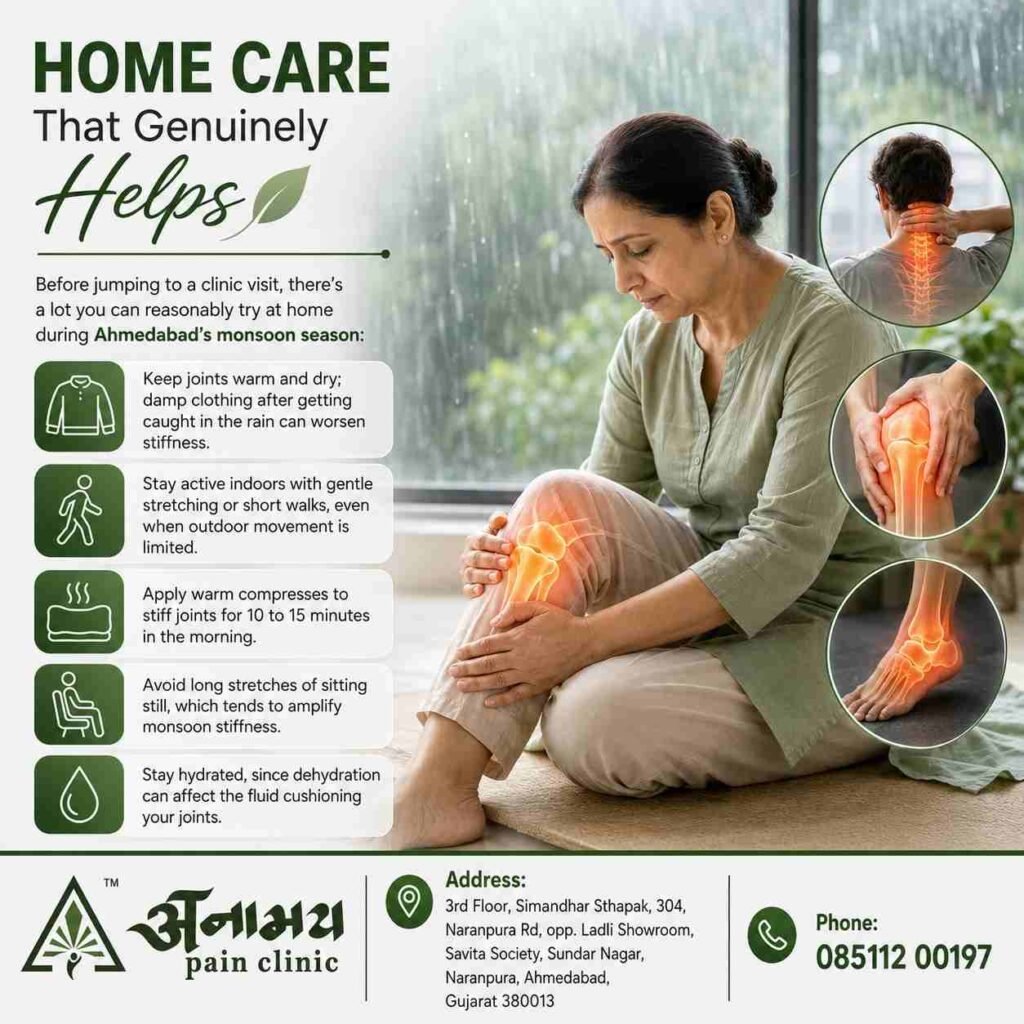
Before jumping to a clinic visit, there’s a lot you can reasonably try at home during Ahmedabad’s monsoon season:
- Keep joints warm and dry; damp clothing after getting caught in the rain can worsen stiffness
- Stay active indoors with gentle stretching or short walks, even when outdoor movement is limited
- Apply warm compresses to stiff joints for 10 to 15 minutes in the morning
- Avoid long stretches of sitting still, which tends to amplify monsoon stiffness
- Stay hydrated, since dehydration can affect the fluid cushioning your joints
For many people, these small adjustments are genuinely enough to get through the season comfortably. The distinction we want to draw here is between ordinary seasonal stiffness and pain that’s telling you something more is going on.
When Monsoon Joint Pain Needs a Specialist
It’s time to stop managing this at home and get evaluated when:
- The pain persists well after home care for more than two to three weeks
- Swelling, redness, or warmth develops around a joint
- Pain is limiting daily tasks like climbing stairs or getting up from a chair
- You notice the same pattern returning every monsoon and getting slightly worse each year
- Over the counter pain relief is no longer giving meaningful relief
If any of that describes what you’re experiencing, please don’t just wait for the season to pass again next year. You can message us directly on WhatsApp to ask whether your symptoms sound like something that needs an in-person evaluation.
How We Treat Joint Pain in Monsoon at Anamay Pain Clinic
Dr. Megha Shah trained in pain and palliative medicine at Tata Memorial Hospital, Mumbai, and Gujarat Cancer Research Institute, Ahmedabad, and is currently affiliated with Apollo Hospital, Ahmedabad. When patients come to us with recurring monsoon flare ups, the goal isn’t just to get through this episode. It’s to understand the underlying joint condition well enough that next year’s monsoon doesn’t hit as hard.
For osteoarthritis and chronic joint pain, this often includes image guided treatments such as ozone therapy, which targets inflammation directly at the joint rather than relying only on oral medication. For back related flare ups, we also draw on the same non-surgical, interventional approach we’ve discussed in our guide on treating back pain without surgery, matched to how severe you’re imaging, and symptoms are.
The goal is always a plan that fits your specific joint, not a generic one size fits all response to “monsoon pain.”
Getting Ahead of Next Year’s Monsoon
If joint pain in monsoon Ahmedabad shows up for you every single year, that repeating pattern is worth taking seriously rather than treating each episode as a one off. A proper evaluation now can tell you whether you’re dealing with ordinary weather sensitivity or an underlying joint condition that deserves real treatment.
Contact us to book a consultation before the next spell of rain, and we’ll help you figure out a plan that holds up season after season, not just until the sun comes back out.
Book Your Consultation with Dr. Megha Shah Today.!
Meet Dr. Megha Shah at Anamay Pain Clinic, one of the leading pain management clinics in Ahmedabad. A highly experienced pain specialist providing personalized, advanced, and minimally invasive treatments for long-lasting pain relief and improved quality of life.
Frequently Asked Questions
Is monsoon joint pain a real medical phenomenon or just a myth?
It’s real for many patients, though the exact mechanism is still debated among researchers. The most consistent finding links falling barometric pressure and rising humidity with increased stiffness and pain in people who already have joint conditions, rather than causing new joint damage on its own.
Does monsoon joint pain mean I have arthritis?
Not necessarily on its own but noticing a clear seasonal pattern is worth mentioning to a specialist, since it can be an early sign of joint changes that haven’t been formally diagnosed yet, especially if the pain has grown a little worse each year.
Can diet help with monsoon joint stiffness?
Staying hydrated and reducing salty, processed foods can support overall joint health, though diet alone typically isn’t enough for patients with an underlying condition like osteoarthritis and should be paired with appropriate medical care.
Should I exercise if my joints hurt more in the monsoon?
Yes, gentle movement is usually better than complete rest. Avoid high impact activity on flare up days, but light stretching or short indoor walks help prevent the stiffness from compounding over the season.
How is monsoon back pain different from monsoon joint pain in the knees or hands?
The underlying weather sensitivity mechanism is similar, but back pain is more often linked to disc or muscular issues rather than joint cartilage, so the evaluation and treatment approach can differ meaningfully between the two.
This article is for informational purposes only and is not a substitute for professional medical advice, diagnosis, or treatment. Always consult Dr. Megha Shah or a qualified healthcare provider before starting any treatment.