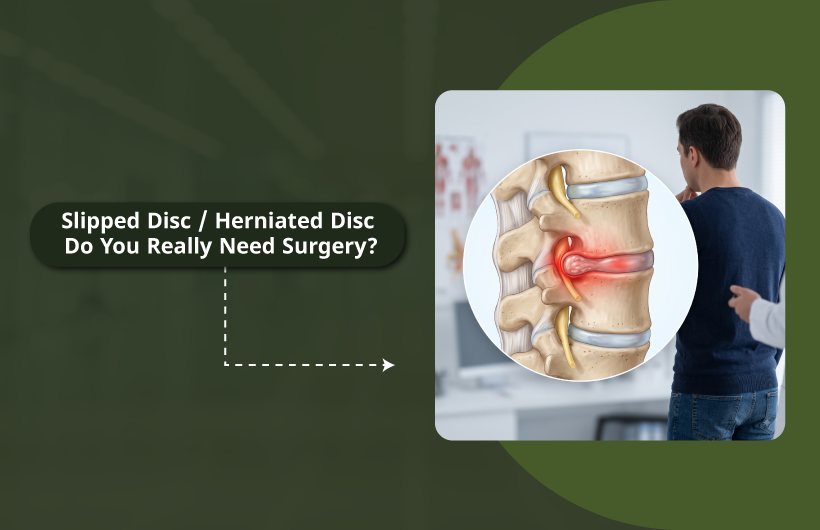
If you’ve just been told you have a slipped disc, the first question on your mind is probably not “what caused this”, it’s “will I need surgery.” For most patients, the answer is no. Most slipped discs respond well to non-surgical slipped disc treatment in Ahmedabad, and surgery is usually reserved for a much smaller group of cases.
That said, “most patients” isn’t the same as “every patient,” and knowing which group you fall into makes all the difference. As a pain management clinic in Ahmedabad, we see this exact worry walk through our door on a regular basis, and it’s worth addressing clearly rather than in vague reassurances.
What Is a Slipped Disc, exactly?
Your spine is made up of vertebrae stacked on top of each other, cushioned by discs that act like shock absorbers. Each disc has a tougher outer layer and a softer, gel-like centre.
A slipped disc, also called a herniated or prolapsed disc, happens when that soft centre pushes through a weak spot or tear in the outer layer. If it presses against a nearby nerve root, it can cause pain, tingling, numbness, or weakness that radiates into the arm or leg, depending on where in the spine it occurs.
This is different from general wear-and-tear back pain, and it’s also different from sciatica, which is a symptom that a slipped disc often causes rather than a separate condition on its own.
What Causes a Slipped Disc?
Age-related degeneration is the most common factor, discs lose some of their water content and flexibility over time, making them more prone to tearing. But a slipped disc isn’t only an “older person’s” problem.
We regularly see it in patients in their 30s and 40s, particularly those who:
- Sit for long stretches without breaks, common with desk jobs and long commutes in Ahmedabad traffic
- Lift heavy objects with poor form, bending from the back instead of the knees
- Have a history of spinal injury or repetitive strain
- Carry excess body weight, which adds pressure on the lower spine
- Smoke, which reduces blood supply to the disc and speeds up degeneration
It’s also worth knowing that not every slipped disc causes symptoms. Some are found incidentally on imaging done for an unrelated reason, and the person has no pain at all. This is one reason imaging alone shouldn’t be the only basis for deciding on treatment, your actual symptoms matter just as much as what shows up on a scan.
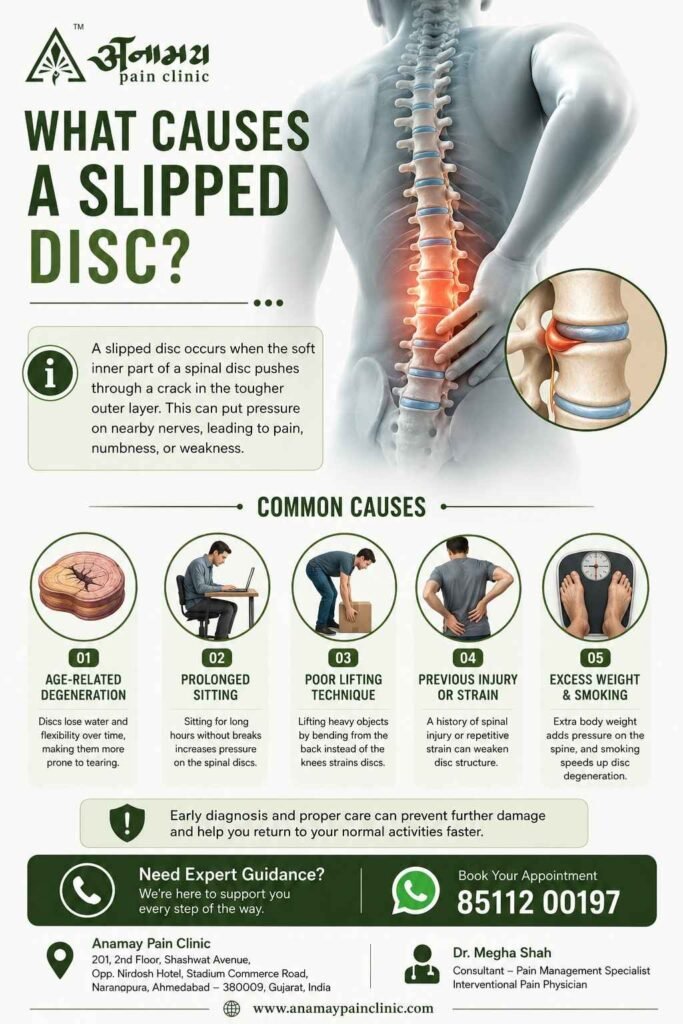
What Causes a Slipped Disc
Do You Really Need Surgery?
Here’s the part most people don’t expect to hear surgery is not the first-line treatment for a slipped disc, and it isn’t even necessary for most patients. Non-surgical care, done properly, is often enough to relieve the pressure on the nerve and let the disc settle.
That doesn’t mean surgery is never appropriate. In some situations, it genuinely is the right call, and we’ll cover exactly when below. But if a slipped disc has just been diagnosed and surgery is the first thing being recommended, it’s reasonable to ask why conservative options weren’t tried first.
We’ve written before about treating back pain without surgery, and the same principle applies here, the goal is always to try the least invasive option that can genuinely relieve your symptoms.
How Slipped Discs Are Treated at Anamay Pain Clinic
Dr. Megha Shah trained in pain and palliative medicine at Tata Memorial Hospital, Mumbai, and Gujarat Cancer Research Institute, Ahmedabad, and is currently affiliated with Apollo Hospital, Ahmedabad. Her approach to a slipped disc starts with confirming the diagnosis through imaging, then matching treatment to how severe the nerve compression is.
For many patients, this means a combination of physical therapy, targeted medication, and activity modification for the first several weeks. When pain persists beyond that point, an epidural injection is often the next step.
An epidural injection delivers anti-inflammatory medication directly into the epidural space around the compressed nerve, reducing swelling and irritation at the source rather than masking pain systemically. The procedure typically takes 30 to 60 minutes, uses image guidance for accuracy, and most patients go home the same day.
It’s not a permanent fix for the underlying disc problem, and it doesn’t work identically for everyone. Some patients get substantial relief from a single injection; others need it repeated or combined with ongoing physical therapy. We’ll always tell you honestly which category your case is likely to fall into, rather than promising a single outcome.
What we won’t do is skip straight to injections without first understanding whether a more conservative approach could work for you. If your symptoms are mild and recent, physical therapy and activity changes alone are often given a fair trial first. The injection becomes relevant when pain is limiting your daily life and hasn’t responded to those initial steps within a reasonable window.
When Is Surgery Actually Necessary?
Surgery becomes the right conversation to have when:
- Symptoms haven’t improved after 6 to 8 weeks of consistent non-surgical treatment
- There’s progressive muscle weakness in the leg or arm
- You experience loss of bladder or bowel control (this is a medical emergency, seek immediate care)
- Imaging shows severe, ongoing nerve compression that conservative care isn’t resolving
If any of these apply to you, please don’t wait it out at home hoping it improves on its own. Reach out to us directly on WhatsApp so we can guide you on the right next step quickly.
Getting Clarity on Your Next Step
A slipped disc diagnosis can feel alarming, especially with so much conflicting advice online about whether surgery is inevitable. For most people in Ahmedabad dealing with this, it isn’t, but the right next step depends on your specific imaging, symptoms, and how you’ve responded so far to conservative care.
If you’re unsure which category you fall into, that uncertainty is exactly what a proper evaluation is for. Contact us to book a consultation, and we’ll walk you through your imaging and options honestly, without pushing you toward a procedure you don’t need.
Book Your Assessment at Anamay Pain Management Clinic, Ahmedabad
Take the first step towards a pain-free life with expert guidance and advanced regenerative treatments tailored to your condition.
Frequently Asked Questions
Can a slipped disc heal on its own?
Yes, in many cases. Mild to moderate slipped discs often improve over several weeks as inflammation reduces and the body reabsorbs part of the herniated material, especially with appropriate activity modification and physical therapy.
How long does non-surgical treatment take to work?
It varies by patient, but most people who respond to conservative treatment notice meaningful improvement within 4 to 6 weeks. Some feel relief sooner, particularly after an epidural injection.
Is bed rest recommended for a slipped disc?
No, prolonged bed rest is generally discouraged today. Staying gently active, within your pain limits, tends to support recovery better than complete immobility.
Does an epidural injection hurt?
Most patients describe mild discomfort during the injection rather than significant pain, since the area is numbed beforehand and the procedure is guided by imaging for precision.
Can a slipped disc come back after treatment?
It’s possible, particularly if the original risk factors, poor lifting habits, prolonged sitting, excess weight, aren’t addressed. This is why we also focus on posture and movement guidance alongside the procedure itself.
This article is for informational purposes only and is not a substitute for professional medical advice, diagnosis, or treatment. Always consult Dr. Megha Shah or a qualified healthcare provider before starting any treatment.