
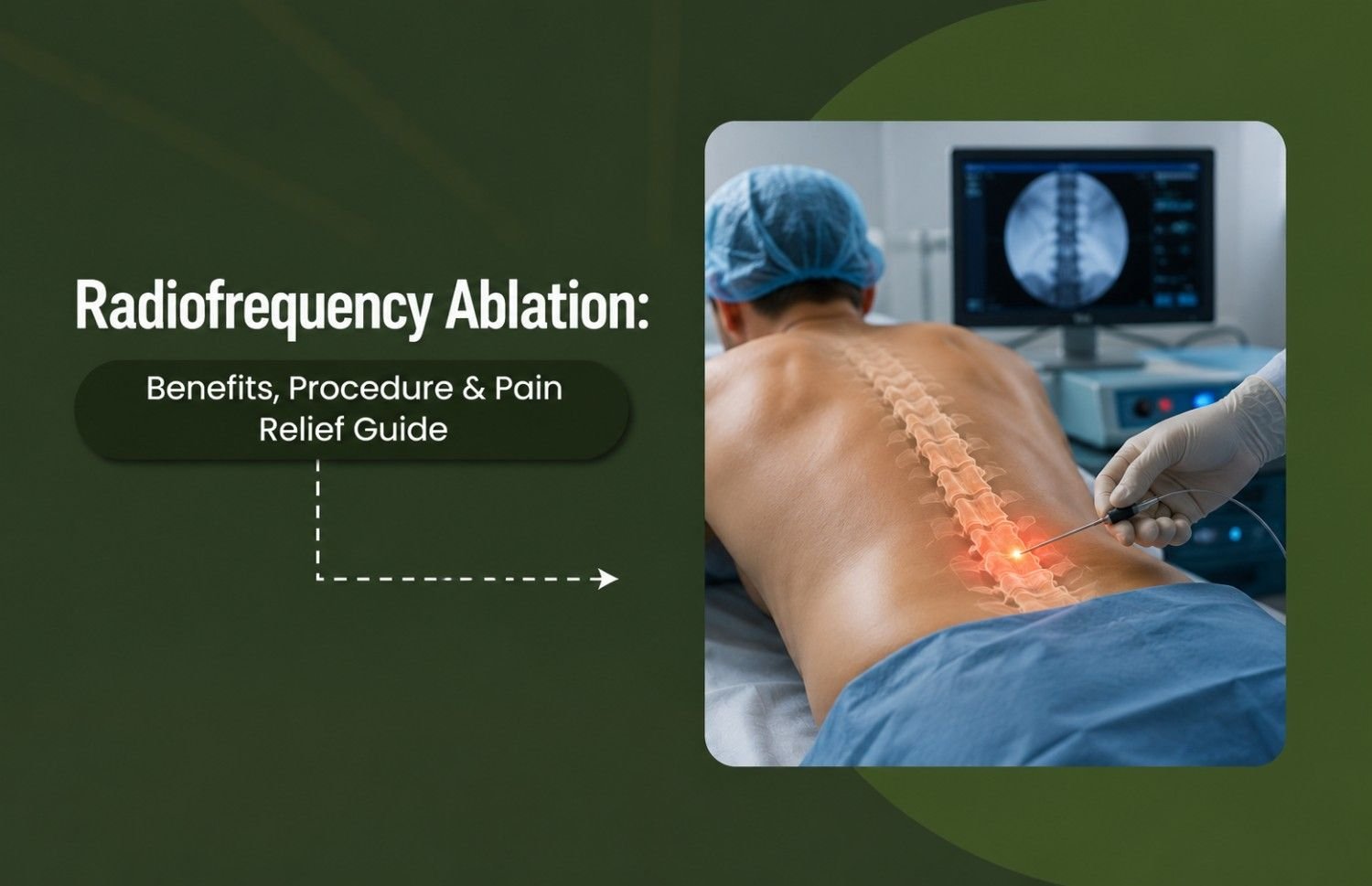
If your doctor has mentioned radiofrequency ablation, or RFA, for your chronic back, neck, or joint pain, the term alone can sound intimidating. “Heat” and “nerve” in the same sentence makes most patients nervous before they even ask a single question. The procedure is far less dramatic than it sounds, and far less invasive than the surgery many patients have already been advised to consider.
At Anamay Pain Clinic in Naranpura, Dr. Megha Shah regularly uses radiofrequency ablation as a non-surgical option for patients who’ve been told surgery is their only path forward. Here’s what the procedure involves, in plain terms.
What Is Radiofrequency Ablation, really?
At its core, RFA uses a thin needle to deliver controlled heat, generated by radio waves, to a small, specific nerve that’s been identified as the source of your pain. The heat creates a tiny lesion on that nerve, which interrupts its ability to send pain signals to your brain.
It’s important to understand what RFA does not do. It doesn’t fix a structural problem like a herniated disc or arthritic joint. It targets the nerve that’s relaying the pain signal from that area, essentially turning down the volume on the pain itself.
This makes RFA particularly useful for pain coming from facet joints in the spine, which are small joints that connect each vertebra and are a common source of chronic back and neck pain that doesn’t show up clearly on standard scans.
How Do You Know If RFA Is Right for You?
RFA isn’t typically the first thing offered. Most patients reach this point after conservative treatments, like physiotherapy, medication, or steroid injections, haven’t given lasting relief.
Before recommending RFA, Dr. Megha Shah performs a diagnostic nerve block first. This is a small test injection of local anesthetic near the suspected nerve. If your pain noticeably drops for a few hours after this test injection, it confirms that nerve is indeed the source, and RFA becomes a strong option. This step matters because it removes the guesswork; you and your doctor know in advance whether the procedure is likely to help before committing it.
RFA is commonly considered for chronic low back pain from facet joint arthritis, neck pain from cervical joints, sacroiliac joint pain, and certain types of knee pain when other nerves are identified as the source.
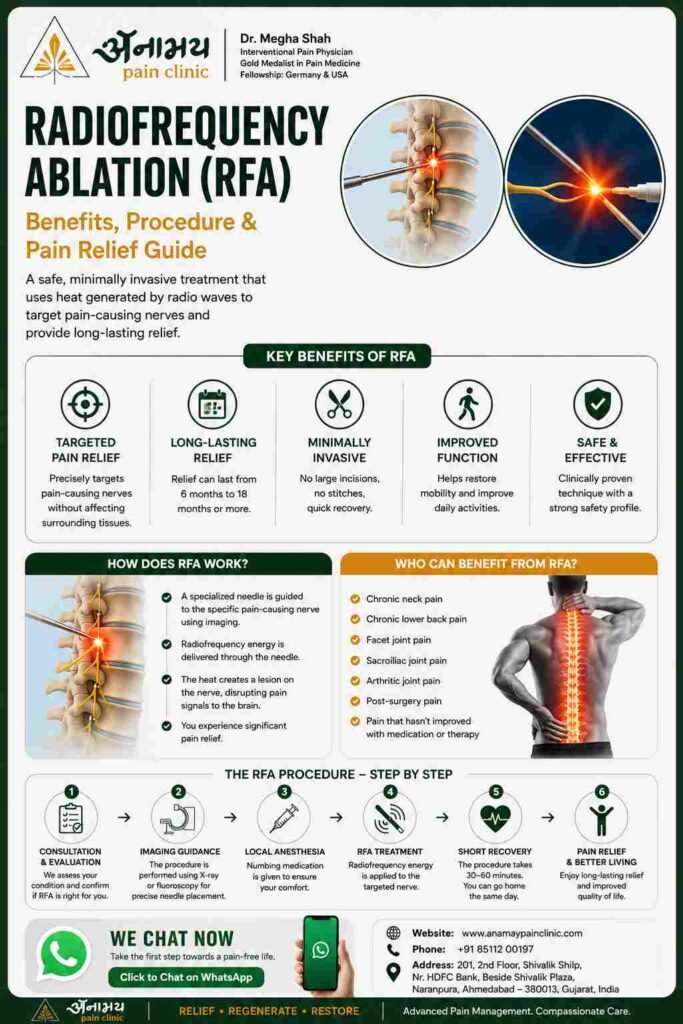
Radiofrequency ablation pain relief guide
What Actually Happens During the Procedure?
The procedure itself is done as a day-care outpatient visit, under local anesthesia, so you’re awake but the treatment area is numbed.
Using live imaging guidance, either a C-Arm or ultrasound, Dr. Megha Shah precisely positions a thin needle near the targeted nerve. A small test stimulation is sent through the needle first, to confirm correct placement and make sure no major nerve or muscle nearby would be affected. Once placement is confirmed, the radiofrequency current is applied for about 60 to 90 seconds per nerve, creating the heat lesion.
Most procedures take 30 to 45 minutes from start to finish, and patients typically go home the same day.
What Should You Expect Afterward?
This is the part patients ask about most, and honesty matters here. It’s common to feel some soreness or mild discomfort at the injection site for a few days, sometimes up to two weeks, as the area settles. Some patients notice their usual pain feels slightly worse for the first few days before it begins improving. This is a normal part of the nerve’s response and isn’t cause for alarm.
Most patients notice meaningful pain relief within one to three weeks. Results commonly last six months to two years, varying by individual and condition. Nerves do eventually regenerate, which is why RFA can be repeated when pain returns, rather than being a one-time fix.
In terms of practical aftercare, most patients can resume light daily activities, like walking or desk work, within a day or two. We typically advise holding off on heavy lifting, intense exercise, or long drives for about a week, and keeping the small needle site clean and dry for the first 24 hours. A short follow-up call or visit is usually scheduled around the two-to-three-week mark, once the nerve has settled, to assess how much relief you’re getting and whether any adjustment is needed.
RFA vs. Other Options: How Does It Compare?
Patients often ask how RFA stacks up against alternatives they’ve heard about.
Compared to steroid injections, RFA tends to last considerably longer, since steroids reduce inflammation temporarily while RFA interrupts the pain signal itself. Compared to spinal cord stimulation, RFA is a simpler, shorter outpatient procedure with no implanted device, though SCS may be considered for more complex, widespread nerve pain where RFA isn’t suitable; you can read more about that option on our spinal cord stimulation page. Compared to surgery, RFA involves no incision, no hospital stays, and a dramatically shorter recovery, though it’s worth being clear that RFA addresses pain signaling rather than correcting the underlying structural issue the way surgery sometimes does.
Sciatica patients often ask whether RFA applies to their condition. Since sciatica involves nerve root compression rather than facet joint pain, RFA isn’t always the first-line treatment there, though it can play a role depending on the specific diagnosis. We’ve covered sciatica-specific treatment options separately on our back pain treatment without surgery guide.
Is RFA Safe?
RFA has a strong safety record when performed by an experienced pain specialist using proper imaging guidance. Serious complications are rare. The most common side effects are temporary: soreness at the injection site, mild bruising, or a brief increase in pain before improvement sets in. Because the procedure targets only sensory nerves responsible for pain, not nerves controlling muscle movement, patients don’t experience weakness or loss of function in the treated area.
That said, RFA isn’t appropriate for everyone. Patients on certain blood thinners, with active infections, or with specific anatomical considerations will need a careful evaluation first, which is exactly what the consultation and diagnostic nerve block are for. Pregnant patients and those with certain implanted cardiac devices also require additional precautions, which Dr. Megha Shah will review with you during your initial consultation before any procedure is planned.
If you’ve been told surgery is your only option and want a second opinion, it’s worth a conversation before deciding. Chat with us on WhatsApp with your questions or come in for a consultation with Dr. Megha Shah.
Conclusion
Radiofrequency ablation sounds far more intimidating than it is. For the right patient, it offers meaningful, longer-lasting relief from chronic back, neck, or joint pain without surgery, hospital stays, or a long recovery. If conservative treatments haven’t worked for you and surgery feels like a leap too far, RFA may be worth discussing. Contact us at Anamay Pain Clinic to find out if you’re a candidate.
Book Your Assessment at Anamay Pain Management Clinic, Ahmedabad
Take the first step towards lasting pain relief with expert guidance, advanced regenerative treatments, and a personalised care plan designed for your condition.
Frequently Asked Questions
Does radiofrequency ablation hurt?
The procedure is done under local anesthesia, so most patients feel pressure rather than sharp pain during the treatment itself. Mild soreness afterward is common and typically resolves within one to two weeks.
How long does the pain relief from RFA last?
Results vary by patient and condition, but relief commonly lasts between six months and two years before the nerve regenerates and the procedure may need to be repeated.
Is RFA a permanent fix?
No. RFA interrupts the pain signal from a specific nerve, but since nerves can regrow, it’s considered a long-lasting treatment rather than a permanent cure. It can be safely repeated if pain returns.
Will I stay in the hospital after RFA?
No, RFA is a day-care outpatient procedure. Most patients go home the same day and resume light activities within 24 to 48 hours.
How do I know if RFA will work for my pain?
A diagnostic nerve block is performed first. If that test injection significantly reduces your pain temporarily, it strongly indicates RFA targeting that same nerve will be effective.
This article is for informational purposes only and is not a substitute for professional medical advice, diagnosis, or treatment. Always consult Dr. Megha Shah or a qualified pain specialist before starting any treatment for your condition.